Shouya MaaS Intelligent Computing Platform
This enterprise‑LLM platform unifies heterogeneous computing, model assets, inference deployment and Token governance for controllable AI infrastructure.



Industry Pain Points
After the enterprise AI moves from experimentation to large-scale application, computing power, models, services, and usage gradually become dispersed, making it difficult for traditional resource management methods to support unified operations.

It is difficult to unify heterogeneous resources
GPUs and NPUs are scattered across different clusters and servers, lacking a unified view of resource specifications, operational status, and utilization, leading to a continuous increase in management costs.

Model assets are difficult to manage
The maintenance of weight files, model images, and runtime configurations is fragmented, and there is a lack of unified standards for model versions and computing power requirements, making deployment preparation complex.

The efficiency of model deployment is low
Model deployment relies on manual judgment of hardware specifications, video memory, and operating environment, lacking a standardized basis for matching resources with models.

Model usage is difficult to manage
After continuous invocations from multiple models and applications, the request volume, token consumption, and API key usage become dispersed, making it difficult to uniformly track costs and abnormal invocations.
Core Product Matrix
Covering computing power resources, model assets, inference services, and model invocation, we establish a complete management chain for enterprise large models, spanning from resource access to service operation.
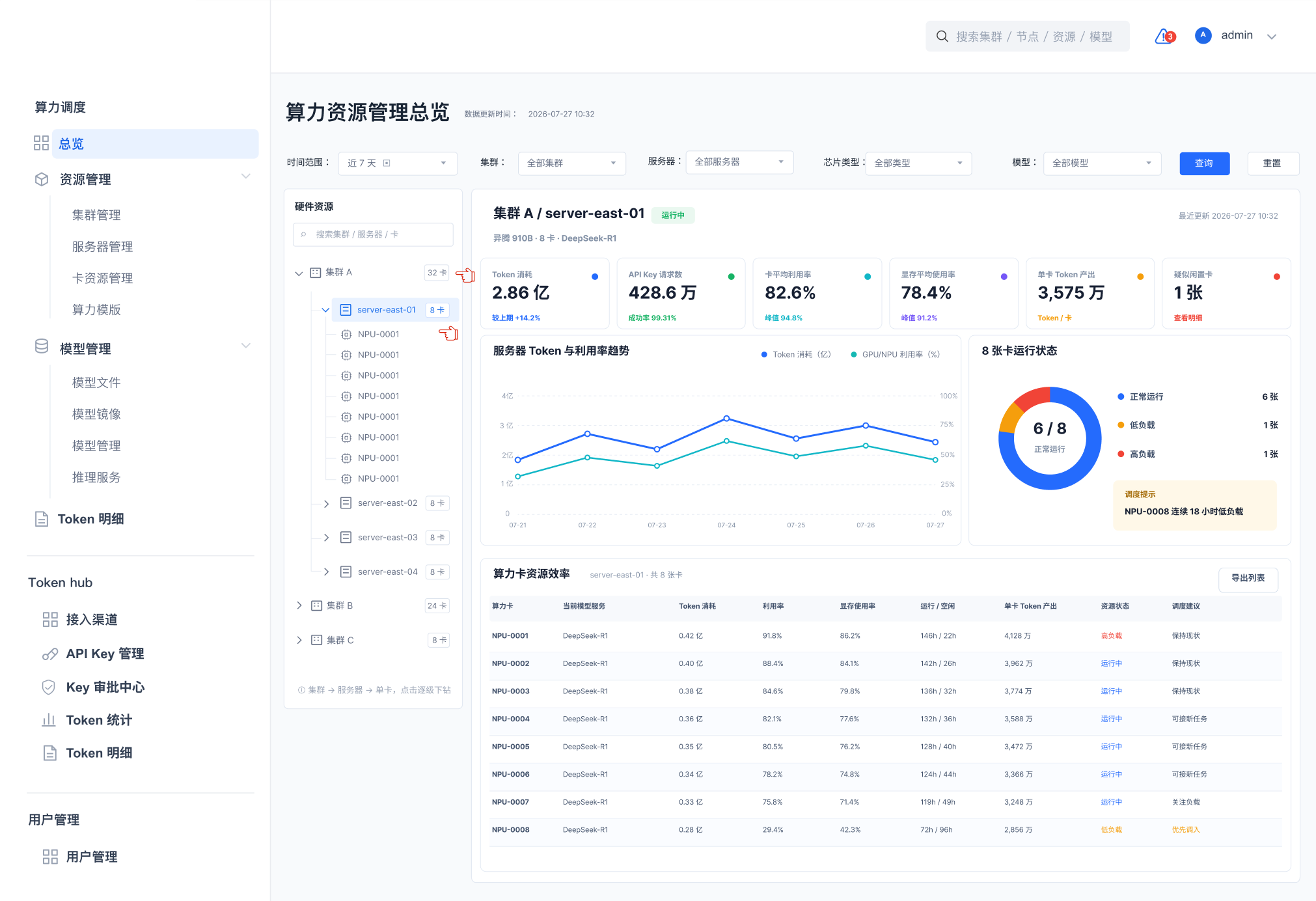
Computing Power Resource Management
One-stop heterogeneous computing management. Adopt auto-discovery, manual & batch import for servers. Build mapping among clusters, servers and cards. Standardize runtime specs via templates to support full lifecycle computing scheduling.
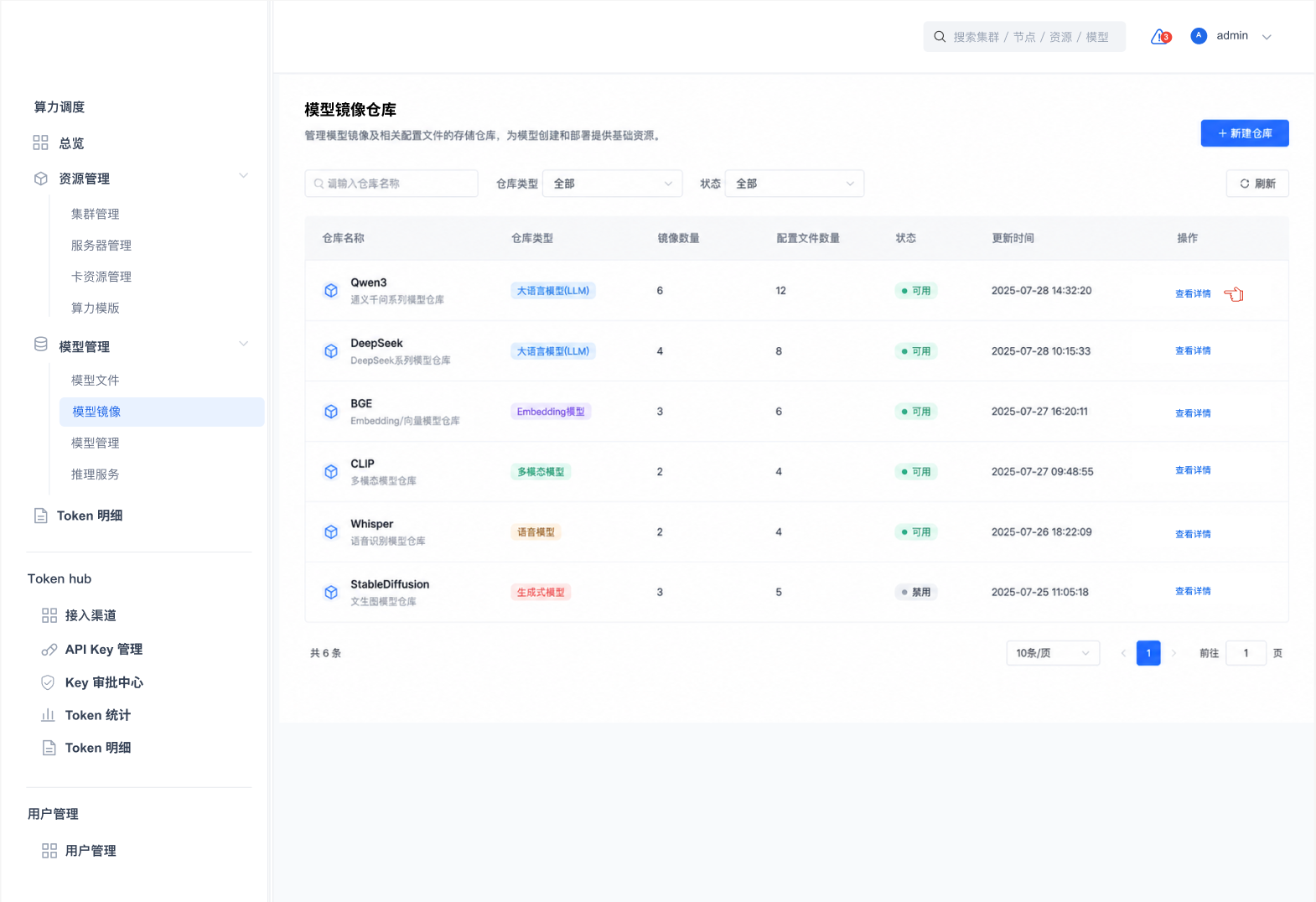
Model weight file
Build a deployable asset system that spans from model files, images, to versions. The platform registers model files through server paths and automatically identifies their attributes, and registers model images according to specifications. The combination of file and image registration generates models and versions. This module provides standardized and reusable model versions for inference services, ensuring that each deployment has clear source, environment, and version baselines.
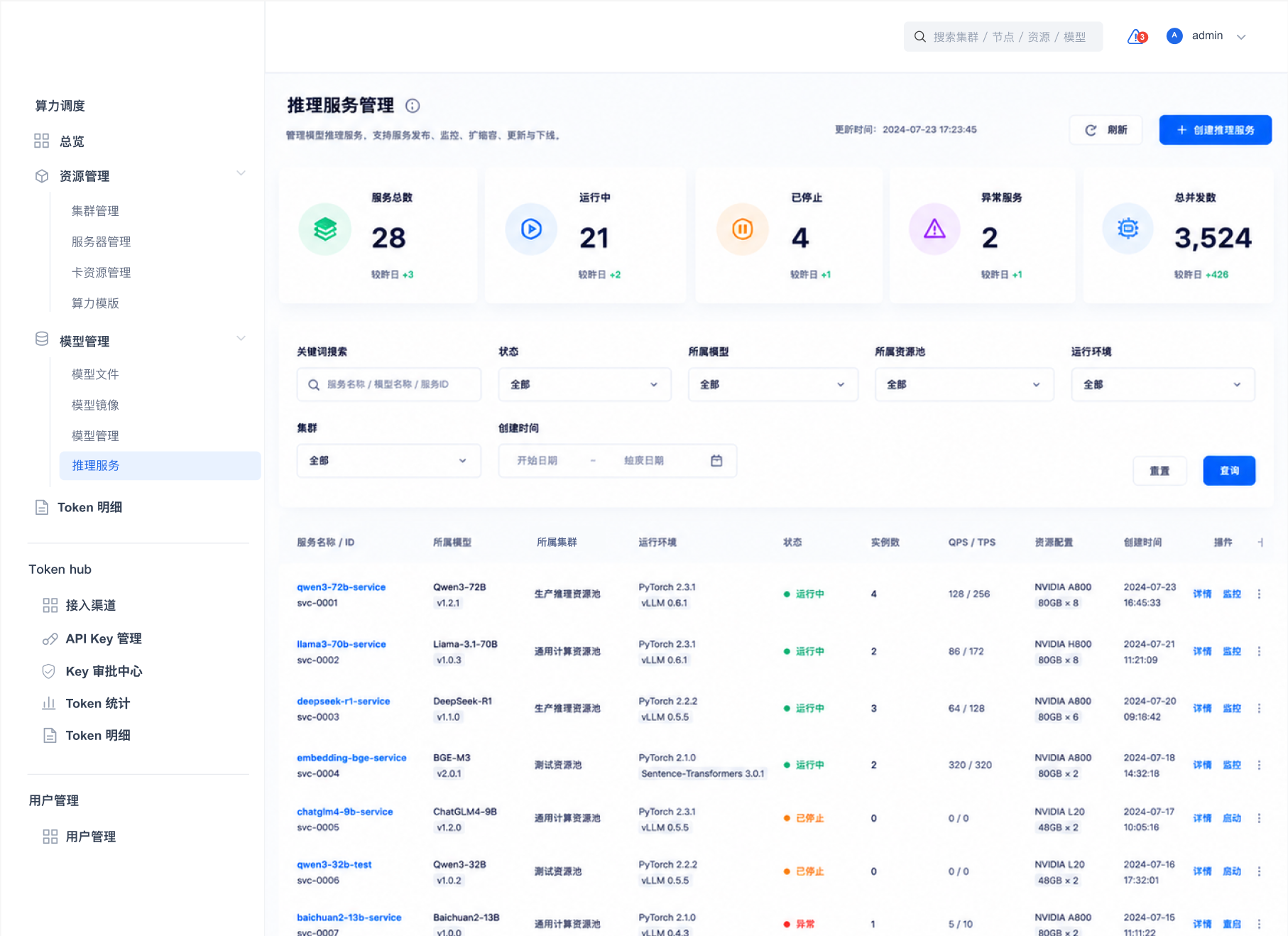
Resource Matching
Quickly launch running services with selected models. Four-step guided deployment with seven pre-checks. Decouple services and instances, support elastic scaling and real-time monitoring.
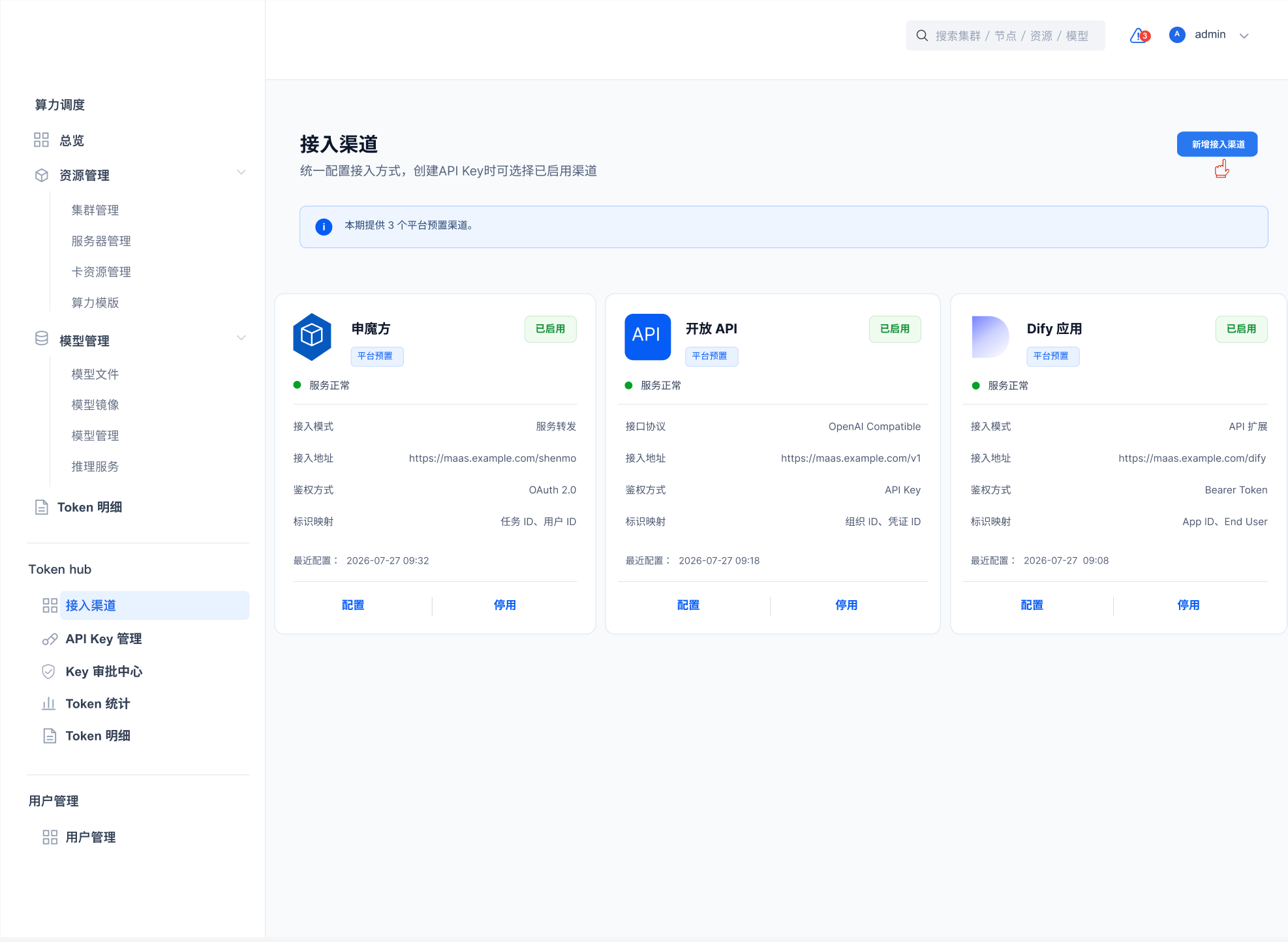
Token Hub
Unify AI service gateway, full lifecycle API Key management and Token statistics. Form closed-loop call tracking without parsing request body, ensure access security and compliance.
Core Advantages
Visible computing power, controllable deployment, traceable consumption

Full-link Bidirectional Tracing
Bidirectional tracing via 5D relations: trace resources from services and vice versa.

Mandatory Pre-deployment Check
Standardize runtime specs; 7 pre-deployment checks eliminate resource mismatches.
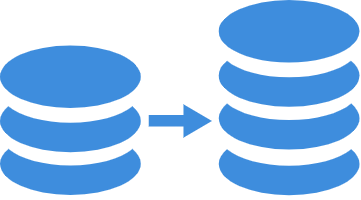
Decouple Services & Instances
Separate services and instances; support elastic scaling with auto resource verification.

Decouple Statistics & Inference
Token Hub independently tracks requests and Token consumption, supports multi-dimensional aggregation.
Customer Cases
Trusted by benchmark clients, proven platform value
Well-known Domestic Rail Transit Group
Adopt Shouya MaaS to unify multi-cluster heterogeneous computing and private model deployment. Realize full lifecycle inference management and refined Token analysis for rail transit business.

Build Full-lifecycle Management Platform for Enterprise Private Large Model Services
Consult Shouya MaaS now, contact our experts for further support.
Contact Us